Sunday, 14 August 2011

Thinking about "people smuggling" and taking care of our language

I have been thinking a lot about the issue of public policy about asylum seekers and the language in which that debate is being conducted. In the New Testament Christians are enjoined to be careful with the language that they use and that injunction surely applies as much to the language that we use in debate about public policy as it does to the language that we use in personal relationships. The need for honesty, truthfulness and respect are relevant characteristics that follow from this injunction.

The term "smuggling" as it is normally used carries connotations of attempts to conceal the items being smuggled from the relevant authorities. The use of the term "people smuggling" with reference to the activities of sailors bringing boat loads of refugees, seeking asylum, seems to me to be totally inaccurate and misleading as an account both factually and morally of what is taking place when a boatload of refugees arrives at Christmas Island.

Those bringing the people to Australia in those boats do not seek to conceal their arrival from the authorities - the point of their arrival is to bring the presence of the refugees to the attention of the authorities at the earliest possible moment after their arrival, so as to make their claim for asylum.

The use of the term "people smuggling" it seems to me is designed to ensure that the activity is judged to be morally obnoxious before the debate even starts. The moral status of the activity of the people supplying transport to asylum seekers needs some careful analysis. The activity may be illegal, it may be reckless, but that does not automatically make the activity immoral, let alone evil. It is difficult to see how the later characterisation could stand, considering that from the point of view of the law, if a person's claim to asylum is acknowledged by the Australian authorities to be a valid one, the means of entry to Australia is not regarded as illegal.

How the activity of assisting refugees to make a valid claim for protection can be regarded as an evil is something I struggle to understand. The activity may be illegal, disruptive of Australian Government policy, reckless of human life, and disorderly. It may indeed be any, and all of the above. But evil?

The other issue that emerges from paying attention to the language and focus of the public debate, is that we are now not discussing the question of how we can achieve a compassionate and just policy with respect to refugees seeking asylum. The policy debate is now framed almost entirely with respect to the effect of policy decisions on the activities of those termed "people smugglers".

The obsession of the Australian Government, media and public at large with this group of people is indeed amazing to behold. The concern with their activities has so hi-jacked the policy debate that we have lost focus on the underlying realities that are driving refugees to seek asylum.

Giving the attention being paid to this group it seems strange that we do not yet have a "Minister for 'People Smuggling'" because that is what the Minister for Immigration seems to have in fact become.
The national obsession with this relatively small group of people is now bordering on the bizarre, in terms of the actual numbers involved and the impact of their activities on the number of asylum seekers arriving in Australia, in terms of both absolute numbers of those who seek asylum in Australia and as a proportion of the total of long term arrivals in Australia under the various immigration programs. We are now spending large amounts of public funds on a range of "non-solutions" that are totally unnecessary.

In such a situation how might Christians respond? We should start with trying to examine carefully the language of public debate and begin unpacking the truthfulness of the assumptions that are embedded in it and the accuracy of the accounts of the policy and moral issues that form much of the media debate around asylum seekers. The call to truthfulness and care in our speech demands no less. Beyond that we can get involved in our local community with groups that seek to meet the needs of asylum seekers and refugees. Get to meet refugees and asylum seekers, listen to their stories, and begin to understand a little of how they see the world.




Saturday, 13 August 2011

Violence, religion and the modern state


What was interesting about the media reporting of the massacre in Norway was that the religious identity of supposed perpetrators emerged in the reporting right from the start. If it was not Islamic terrorists that were responsible as first thought, the attention turned to the "fundamentalist Christian".

The political theologian William Cavanaugh has some helpful comments on this tendency. In his review of Charles Kimball's book When Religion Becomes Evil. Kimball, he observes ... wants to proscribe religious justifications of vilence because he belives that religion, with its absolutist tendencies is prone to fan the flames of violence.
... The problem is that there remain in Kimball's view, perfectly legitimate non-religious, or "secular" ways of justifying violence. Far from a condemnation of violence, Kimball's analysis results in a selective condemnation of certain kinds of violence, labelled "religion". the problem is not violence as such; there are still occasionally good reasons for bombing or shooting people. To qualify as good these reasons must be "secular".  "Secular" violence. however regrettable, is sometime necessary. "Religious" violence is always reprehensible.  (p45 )“Sins of Omission: What ‘Religion and Violence’ Arguments Ignore.” The Hedgehog Review: Critical Reflections on Contemporary Culture 6:1 (Spring 2004): 34–50.
The conclusion Cavanaugh draws that is relevant to the issue of considering the way we talk about the massacre in Norway, by an individual, or the current activities of the Syrian army, to quote an example at random, is that if we really want to address the problem of violence in the modern world, we must treat violence as the problem, whoever is responsible for it.An adequate approach to the probem he argues,
... would be to be resolutely empirical: under what conditions do certain beliefs and practices, jihad, the invisible hand of the market, the sacrificial atonement of Christ, the  role of the United States as a world wide liberator turn violent. The point is not simply that "secular" violence should be given equal time with "religious" violence. The point is that the distinction between "secular' and "religious" violence is unhelpful, misleading and mystifying and should be avoided altogether. (p50)


Wednesday, 10 August 2011

Of gods and men - reflecting on the film through Revelation

Occasionally a film will engage me deeply, its story, the characters, the scenes recurring in memory, touching the heart and challenging the conscience. Of gods and men is one of those films. Some friends of mine have been back to see it a second time, already.

As an account of martyrdom, of loving your enemy, and being present with the poor and marginal in the context of a very dirty war on terror in Algeria in the mid 1990's, based on a true story, this is a stunner. It is beautifully shot, and wonderfully acted. A patient exploration of a community of Trappist monks dealing with the issue of what their vocation and commitment to the way of discipleship means in a time of threatening violence and deep injustice. It is a retelling which recaptures the tensions around their decision-making process, in which we are reminded again and again that at the heart of what they are about is the cycle of worship and prayer, the chanting of the psalms and the reading of the scriptures that shapes what they are becoming and what in the end drives their decision to stay with the Muslim village that they continue to serve.

I won't attempt to do a review of the film, or attempt to tell the story in any detail. If you are interested in a range of views, from a diverse bunch of reviewers, from people of faith to those outside, check out the following links. They are some good You=tube extracts of scenes from the movie on some of them.

Interesting Links:
Of Gods and Men (film) - Wikipedia, the free encyclopedia
Of Gods and Men – review | Film | The Guardian
Of Gods and Men « Notes & Quiddities
OF GODS AND MEN (Why we need St. Benedict more than ever) « Ecclesiastical Graffiti
Of Gods And Men (2010,France) « Andygeddon
Of Gods And Men | Movie review: 'Of Gods and Men' - Los Angeles Times
Film review – Of Gods and Men (2010) « Cinema Autopsy
Father James Martin, SJ: “Of Gods and Men” | Religion & Ethics NewsWeekly | PBS

What I want to do is to just point you to some of the theological issues and biblical context against which, as a Christian, I found myself trying to understand the path that they took.

The film title is taken from  Psalm 82 verses 6-7, underlined. I have reproduced the entire Psalm because I think it is worth thinking about in view of the trajectory of the movie. Who are the gods and who are the men? Is the movie title referring to the pretensions of those who think that violence is the key, as opposed to the monks who seek to treat all, including those who might do them violence as children of God?

 1 God presides in the great assembly;
   he renders judgment among the “gods”:
 2 “How long will you[a] defend the unjust
   and show partiality to the wicked?[b]
3 Defend the weak and the fatherless;
   uphold the cause of the poor and the oppressed.
4 Rescue the weak and the needy;
   deliver them from the hand of the wicked.
 5 “The ‘gods’ know nothing, they understand nothing.
   They walk about in darkness;
   all the foundations of the earth are shaken.
 6 “I said, ‘You are “gods”;
   you are all sons of the Most High.’
7 But you will die like mere mortals;
   you will fall like every other ruler.”

 8 Rise up, O God, judge the earth,
   for all the nations are your inheritance.

Michael J Gorman in Reading Revelation Responsibly: Uncivil Worship and Witness: Following the Lamb into the New Creation (Cascade Press, 2011) observes in terms that are relevant to the story in the movie and the rejection by the monks of the offer of protection by the Algerian military, that:
The current dearth of martyrs in the Western church may be welcome, but its accompanying amnesia of past martyrs and our ignorance of martyrs elsewhere in the world are tragic. In addition to failing at practicing the community of saints, this lack also feeds the desire for national heroes and martyrs. In church history, there has also been a strong correspondence between truly Christian heroes and martyrs and the presence of religious-like commitment to the nation state and its heroes and martyrs - ie., civil religion.
This is very relevant in thinking about the rejection by the monks of military protection and of the attempt by the guerillas to bring their weapons with them when they invade the monastery in search of medical assistance,

The Book of Revelation is associated by many Christians with violence and fighting and may seem a strange biblical resource to bring into consideration in the context of non-violent, enemy loving practices of the monks. That association is substantially wrong.

A further consideration of the relevance of the message of Revelation, with its focus on the slain Lamb and the waiting of the saints to the story of this movie is signaled by the comments by Gorman towards the close of his discussion in Reading Revelation Responsibly, in the chapter entitled "Following the Lamb: The Spirituality of Revelation". This account captures much of what the monks were grappling with in reading the decision to stay. To read Revelation correctly is to understand what their stance was all about. Revelation lived out at the end of the twentieth century.
The resistance (discerning, imaginative and self-critical) required of Christians can be likened to warfare in search of victory. But because this victory is of the victorious slaughtered lamb, Christian resistance to empire conforms to the cruciform pattern of Jesus Christ and his apostles and saints, faithful, true, courageous, just and nonviolent. ... It is important here to emphasise how Revelation conveys a spirituality and ethic of non-violence ... Jesus has already demonstrated both how God deals with evil and how god's people are to deal with evil.  ... not in a show of violent power, but in a paradoxical and subversive act of not confronting evil on its own terms. ... Revelation knows that true spiritual existence is warfare, but it defines victory in the cosmic battle as faithfulness. Neither the Lamb, nor his followers fight in any other way than faithfulness , even to the point of suffering and death. (p.183)
The other important resource that fills in some of the background that is not dealt with in the film and assists in coming to grip with the Prior, Christian's approach to Islam, is the wording of a testament written not long before his death.
The folowing testament was composed by Dom Christian de Cherge in Algiers, December 1, 1993 and produced in Tibhirine, January 1, 1994. It was opened on Pentecost Sunday, 1996, shortly after Dom Christian and others of his Trappist community were murdered in Algeria.

In an early scene in the movie he is seen composing this document, visible on the desk are The Rule of St Benedict, The Little Flowers of St Francis and a copy of the Koran.
If it should happen one day—and it could be today—that I become a victim of the terrorism which now seems ready to encompass all the foreigners in Algeria, I would like my community, my Church, my family, to remember that my life was given to God and to this country. To accept that the One Master of all life was not a stranger to this brutal departure. I would like them to pray for me: how worthy would I be found of such an offering?

I would like them to be able to associate this death with so many other equally violent ones allowed to fall into the indifference of anonymity. My life has no more value than any other. Nor any less value. In any case, it has not the innocence of childhood. I have lived long enough to know that I share in the evil which seems, alas, to prevail in the world, and even in that which would strike me blindly. I should like, when the time comes, to have a space of lucidity which would enable me to beg forgiveness of God and of my fellow human beings, and at the same time to forgive with all my heart the one who would strike me down.


I could not desire such a death. It seems to me important to state this. I don’t see, in fact, how I could rejoice if the people I love were indiscriminately accused of my murder. It would be too high a price to pay for what will be called, perhaps, the “grace of martyrdom” to owe this to an Algerian, whoever he may be, especially if he says he is acting in fidelity to what he believes to be Islam.


I know the contempt in which Algerians taken as a whole can be engulfed. I know, too, the caricatures of Islam which encourage a certain idealism. It is too easy to give oneself a good conscience in identifying this religious way with the fundamentalist ideology of its extremists. For me, Algeria and Islam is something different. It is a body and a soul. I have proclaimed it often enough, I think, in view of and in the knowledge of what I have received from it, finding there so often that true strand of the Gospel learned at my mother’s knee, my very first Church, precisely in Algeria, and already respecting believing Muslims.


My death, obviously, will appear to confirm those who hastily judged me naive or idealistic: “Let him tell us now what he thinks of it!” But these must know that my insistent curiosity will then be set free. This is what I shall be able to do, if God wills: Immerse my gaze in that of the Father, to contemplate with Him His children of Islam as He sees them, all shining with the glory of Christ, fruit of His Passion, filled with the Gift of the Spirit whose secret joy will always be to establish communion and to refashion the likeness, playing with the differences.


This life lost, totally mine and totally theirs, I thank God who seems to have wished it entirely for the sake of that JOY in and in spite of everything. In this THANK YOU which is said for everything in my life, from now on, I certainly include you, friends of yesterday and today, and you, O my friends of this place, besides my mother and father, my sisters and brothers and their families, a hundredfold as was promised!


And you too, my last minute friend, who will not know what you are doing, Yes, for you too I say this THANK YOU AND THIS “A-DIEU”-—to commend you to this God in whose face I see yours. And may we find each other, happy “good thieves” in Paradise, if it please God, the Father of us both. . . AMEN!


‪


Wednesday, 13 July 2011

Mortality of the nation state and the risks of nuclear proliferation

Don't get me wrong - I strongly in favour of action to prevent the proliferation of nuclear weapons. I have often, however, reflected on the hypocrisy of those states with nuclear weapons acting occasionally, vigorously, to restrict their spread.

"You can trust us" is the implication, we are not crazy like those other states for whom possession of these weapons might prove a risk. "You can't let states that might have crazy leaders get hold of them". "We are rational democratic states, we don't get crazy people in charge, who might start waving them around".

Leaving aside that the logic  of deterrence involves creating the impression that you might be crazy enough to actually use nuclear weapons, their is another critical assumption in the rationale that rarely gets unpacked. Lee Griffith in The War against Terrorism and the Terror of God (Eerdmans, 2002) nails it nicely.
There are no Reichs to last a thousand years, no empires on which the sun  will never set. Like the Soviet Union, like Rome, like Babylon, the United States will surely pass away. Like treasures, nations are consumed by moth and rust (Matthew 6: 19). The life span of nations is much shorter than the half life of most nuclear materials. A failure to acknowledge that the weapons we disperse, and the weapons we possess, will someday be possessed by other hands is simply hubris. (p.82)

Saturday, 9 July 2011

The reality of the Holocaust and the value of human life

Watching from a distance the implosion this week of The News of the World has had the awful appeal of watching a disaster in slow motion. You can see it coming, you know you really have better things to do with your life but the appalling inevitability of events calls for your attention with a degree of hypnotic power.

The entire shenanigans certainly won't do much for the not terribly public regard for the profession of journalism. It so happened that this week I have been reading a selection of the writings of one of those journalists whose contribution reminds us that there are some who stand out through their moral sensibility and their concern with the way language is used. I refer of course to Robert Fisk, in this case to his collection of columns in The Age of the Warrior: Selected Writings.

Throughout Fisk's writings is a concern for care in the use of language and a rooted antipathy to politicians whose misuse of language and unwillingness to go anywhere the truth in their justification of war.

There is a also a deep concern throughout Fisk's journalism that human life should be respected and it was a few lines on this issue that caught my attention. In the course of his discussion of the diary of Klemperer's account of the Holocaust he quotes a comment from Khatami a former president of Iran responding to the current President Ahmadinejab who apparently views the holocaust as myth, who observed that "The death of even one Jew is a crime", While this reply starts with the specific issue of the holocaust of Jews it pushes the moral issue beyond that of the ethnic identity of the victims.

Fisk goes on to observe that "Indeed his words symbolised something more crucial: that the importance and the evil of the Holocaust do not depend on the Jewish identity of the victims. The awesome wickedness of the Holocaust lies in the fact that the victims were human beings just like you and me." (p.143)

Yes indeed, and those who have been the victims of other episodes of attempted genocide have their claim on us because they too were human beings, not because of their ethnic identity.

Friday, 8 July 2011

The tragedy of asylum seekers and other displaced people

I didn't watch the ABC documentary on the Tampa last night because that issue is one of those guaranteed to make me very angry - I feared it would become "a near occasion for sin".

However I did find myself drawn into watching some of the Q&A afterwards. As I thought about the way the questions and responses went it occurred to me that the lack of clarity about the numbers of people who are refugees and the different categories of refugee enabled us, as Australians debating the issues to avoid facing some important questions.

No matter how large the numbers of those seeking asylum are on a global scale, they are nowhere near the total number of refugees across the globe. Many are displaced people within their own countries. Many more are displaced people outside the land of their origin who want to go home.

The moral issue of how we deal with asylum seekers and refugees who seek to come to Australia is important. No question but we need some perspective here. The number of people coming via boats is in the order of 2-3,000 per annum at the moment. The number who seek asylum after arriving in Australia by air is around 9,000 per annum. The fear and anger in the Australian community over this number of people coming by boats is out of all proportion to the numbers involved - contra Scott Morrison.

Surveys have shown that most members of the Australian community think the numbers involved are much larger, 100 times larger and neither of the major political parties have seen fit to get out their and educate people about the facts. Instead we have appeals to fear and prejudice and blatant attempts to de-humanise the people involved. Why we are so vulnerable on this point is an issue that needs thought and self critical reflection that will take us beyond simply using labels like xenophobia as David Marr did last night.


Beyond that the focusing on the relatively small group of asylum seekers coming by boat enables us to dodge consideration of the reality of the much larger groups of displaced people in the world and our implication as a nation or as consumers in helping create the situation that led to that displacement.

For example, our involvement in the war in Iraq helped fuel a massive displacement of people both within and outside Iraq. Our ongoing involvement in the war in Afghanistan implicates us not only in the creation of Afghan refugees but also in the flow over effects into Pakistan and the displacement of people within that country.

On the economic front some of the immense displacement of people in the Democratic Republic of the Congo and surrounding countries in the Great Lakes region of Africa has been fueled by the push for minerals to sustain our consumption of the goods in which they are incorporated and I won't even go on to discuss the displacement of people in civil warsarising from struyggles for the control of diamonds.

So by all means let us explore thoughtfully the issue of how we are as a nation-state to respond to the claims of the vulnerable and displaced who come seeking asylum. Let us not become so obsessed that we assume that even achieving a relatively just and compassionate policy will exhaust our responsibility towards the displaced people across the globe. We are all deeply implicated in their condition. We are more truly and deeply than we might want to acknowledge our bother's and sister's keepers.

Wednesday, 6 July 2011

Messianic Americanism - where did it start?


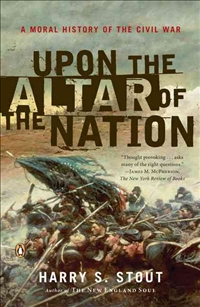
Harry Stout in Upon the Altar of the Nation: A Moral History of the Civil War (Penguin, 2007) set out to under take an assessment of the war using just war criteria. I don't think he succeeds all that well in that particular task, not helped by the fact that he doesn't deal with the complexity and ambiguity of the history of the criteria.

That relative failure may not matter all that much because he has done something that is much more interesting and relevant for Australians. He has presented an interesting argument as to why and how the theological arguments developed on both sides of the conflict to underpin a new sense American messianism that emerged as one result of the war.

Stout's account of the dynamic interaction of the progress of the war with the arguments that were developed by the churches and clergy on both sides to justify their support for their respective governments looks plausible or at least arguable and is underpinned by a wealth of documentary evidence from sermons, printed and unprinted by which he tracks the trajectories of the argument as they developed in response to the ebb and flow of the war.

The Civil War was the crucible of modern US identity. If you want to understand how that sense of nationality acquired its deeply religious, messianic character then a reading of Upon the Altar of the Nation will repay a thoughtful reading.

It also provides a reminder of how much the language of religion has now become taken over by the state to justify its use of violence. The "holy" has well and truly "migrated" as William Cavanaugh has recently reminded us. Indeed I am inclined to argue that Stout's work stands as a helpful case study of that migration in the American context.